
National Safety Council first aid training teaches workers to recognize and respond to injuries and medical emergencies in the first critical minutes, before professional help arrives. For a construction crew, a first aid awareness course is often the right starting point. It covers the fundamentals: assessing a scene, controlling bleeding, treating burns, responding to cardiac emergencies, and knowing when to call for help.
Why does it matter on a job site? Falls, cuts, struck-by incidents, and heat-related illness don’t wait for an ambulance. A trained coworker can make a real difference while emergency services are on their way, especially on remote or large sites where response times stretch.
Before you enroll anyone, though, check how the course lines up with Canadian requirements. First aid rules are set provincially and territorially, so the training you need depends on where your crew works, your site size, and your headcount. An awareness course builds valuable skills, but it may not satisfy every regulatory standard on its own.
This guide breaks down what the training involves, what a construction-focused course covers, and how to choose and put it in place. At Call A Contractor, safety training and responsive customer support are central to how we help crews work well, so we’ve kept it practical.
Why First Aid Awareness Matters on a Construction Site
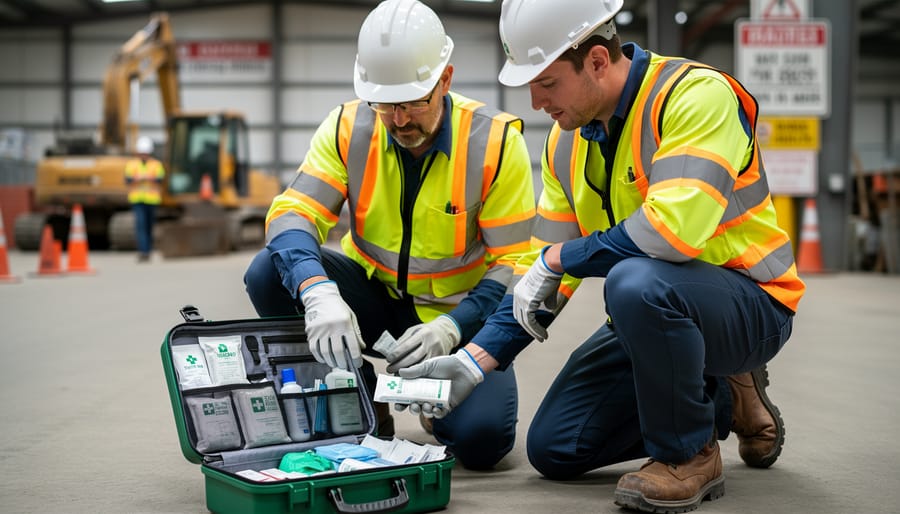
The Gap Between Injury and Emergency Response
Construction sites are rarely easy to reach in a hurry. A busy laneway, a locked gate, a half-finished road or a site tucked behind a rural access route can all slow down an ambulance, even after someone has made the call. Inside the fence, heavy equipment, material stacks and temporary barriers can block the quickest path to an injured worker.
That gap matters. Research on how a delayed response affects outcomes shows why the first minutes carry so much weight, especially with severe bleeding or a person who has stopped breathing.
This is where your own crew becomes the first line of care. A trained worker can check the scene, call for help with clear directions, control bleeding and keep the person stable until paramedics take over. Knowing the site address, the best access route and where the first aid kit is kept makes that handoff faster and safer.
What Awareness-Level Training Adds to Your Safety Program
An awareness course adds a layer to your safety program; it does not replace one. Formal first aid certification still belongs with your designated first aiders, and your written site safety plan still sets out who does what in an emergency. What awareness training does is raise the baseline for everyone else on the crew.
Think of the worker who spots a hazard before it becomes an injury, or the labourer who knows to call for help, secure the scene and stay with the person until the designated first aider arrives. Those small, confident actions often shape the outcome. An awareness course gives every worker a shared vocabulary and a clear set of first steps, so nobody freezes when something goes wrong.
It also supports your existing plan. When crews understand why the emergency procedures exist, they follow them more consistently. Combined with certified first aiders and well-stocked kits, awareness training helps close the gaps that a plan on paper cannot cover alone.
Understanding National Safety Council First Aid Training
Core Skills Covered in a First Aid Course
Most first aid courses build on the same foundation, and a construction-focused session is no exception. Here are the core skills you can expect to practise.
Scene assessment. Before helping anyone, you check for ongoing dangers such as unstable materials, moving equipment or live power. Crews learn to make the area safe first so a second person doesn’t become a second casualty.
Calling for help. Participants learn when and how to contact emergency services, what details responders need, and how to direct someone to meet them at the site entrance.
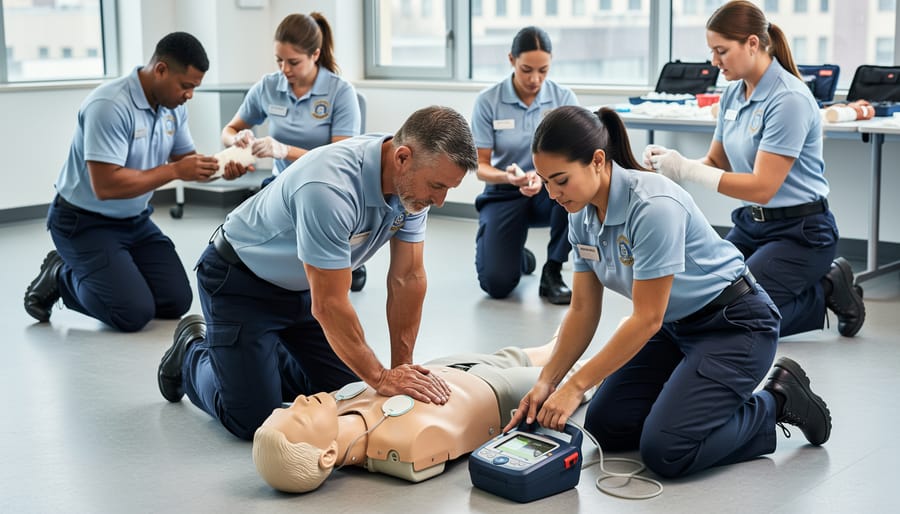
CPR and AED use. Hands-on practice covers chest compressions and rescue breaths, along with using an automated external defibrillator (AED), a portable device that guides you through restoring a normal heart rhythm.
Bleeding control. You’ll practise applying direct pressure and dressings to slow serious bleeding from cuts, crush injuries or tool accidents.
Burns and fractures. Training covers cooling burns correctly and supporting a suspected broken bone without causing further harm.
Recognizing shock. Learners study the warning signs, such as pale, clammy skin and a rapid pulse, and the steps that keep an injured person stable until paramedics arrive.
Together, these skills give every worker a clear, repeatable response plan.
Awareness Course vs. Full Certification
An awareness-level session and a full certification course aim at different goals. Awareness training builds shared knowledge across the crew, so everyone can recognize an emergency, call for help and take the first safe steps. Full certification trains a person to act as the site’s designated first aider, with deeper hands-on practice and a formal credential.
Here’s how the two compare on a typical job site:
| Course type | Typical audience | Depth of skills | Best use on site |
|---|---|---|---|
| Awareness-level session | General crew, new hires, subcontractors | Core response steps and hazard recognition | Building baseline readiness across the whole project |
| Full certification course | Designated first aiders and site supervisors | Extended practice in CPR, AED use and injury care, with a credential | Providing recognized first aid coverage on each shift |
For most projects, the strongest approach is to use both. Send your supervisors and designated first aiders for certification, and bring the rest of the crew through an awareness session so no one is left guessing in those first critical minutes. Before you decide how many people need full certification, check your provincial or territorial workplace safety authority, since required first aider numbers and recognized training vary by jurisdiction.
What a First Aid Awareness Course for Construction Sites Typically Covers
Site-Specific Scenarios Crews Practice
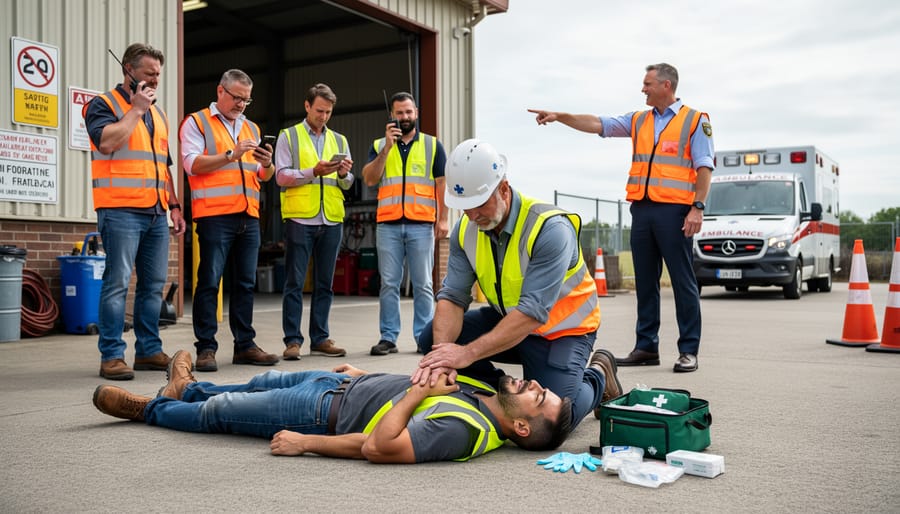
A good construction-focused course doesn’t rely on generic textbook examples. It puts crews through situations they could face on their own sites, so the response steps feel familiar when pressure is high.
A common scenario is a fall from a ladder or aerial work platform. Crews practice checking the scene for hazards, keeping the injured worker still when a back or neck injury is possible, and calling for help with a clear site address and access directions.
Equipment-related injuries are another focus. Training around heavy equipment safety usually includes shutting down machinery safely, controlling severe bleeding with direct pressure, and treating crush or laceration injuries until responders arrive.
Weather brings its own challenges. In summer, crews learn to spot heat exhaustion early, move the worker to shade, and cool them down. In winter, the same practice applies to cold exposure and the warning signs of hypothermia.
Finally, courses address chemical and airborne hazards. Crews practice flushing eyes and skin after chemical contact and responding to breathing difficulty from fumes. Understanding dust exposure risks helps workers recognize symptoms sooner and act with confidence.
Who on Your Team Should Attend
Start with site supervisors. They set the tone for safety and are often the first person called when something goes wrong, so they should be among the first to attend. If your supervisors are confident in a emergency, the rest of the crew will follow their lead.
Equipment operators come next. They work near heavy machinery, lifts and power tools, which puts them close to the most serious injury risks. They are also often the first to spot a problem.
New hires should attend early, ideally before or shortly after they start. A worker unfamiliar with the site layout is the one most likely to freeze in an emergency.
Subcontractors are easy to overlook. If one trade has trained workers and another has none, coverage has gaps. Ask subs to confirm their training, or invite them to your sessions, so every shift has someone ready to act.
How to Choose the Right Training Option for Your Crew
In-Person, On-Site and Blended Formats
Choosing a delivery format comes down to your crew size, schedule and how much downtime the project can absorb.
In-person classes at a training centre give workers a focused, distraction-free setting, which suits individual hires or small groups. On-site training brings the instructor to your job. Crews practise in the same environment where they work, and you avoid travel time and lost hours. It also lets instructors build drills around your actual layout, such as equipment injury response near the machines your team uses every day.
Blended formats pair online theory with a shorter hands-on session. Workers complete the classroom portion on their own time, then practise skills like CPR and bleeding control in person. This works well for crews with staggered shifts.
Whatever you choose, confirm the provider and certificate meet your provincial or territorial requirements.
Confirming Canadian Requirements and Certificate Validity
Before you book any course, check with your provincial or territorial workplace safety authority. Each jurisdiction sets its own rules on how many first aiders a site needs, what a first aid kit must contain, and which training providers and certificates it recognizes. A course that satisfies one province may not be accepted in another, so confirming this up front protects both your crew and your project schedule.
Refresher timing varies too. Many jurisdictions expect first aid certificates to be renewed every two to three years, and CPR skills are often refreshed more frequently. Your local authority will have the exact interval for your region.
A simple tracking sheet kept with your site safety documents makes it easy to see who is current and who is due. That small habit keeps your first aid coverage consistent across the whole project.
Putting First Aid Readiness Into Daily Site Operations
Equipping the Site: Kits, Stations and Emergency Plans
A well-trained crew still needs the right tools within reach. Start with a first aid kit sized for your crew and stocked for construction injuries, including bandages, dressings, burn care, eye wash and gloves. Check the contents regularly and replace anything used or expired. Confirm kit requirements with your provincial or territorial workplace safety authority, since contents and numbers vary.
Place stations where people actually work, clearly marked and free of clutter. Treat them like any other piece of site gear: a quick inspection routine, similar to the habits behind good equipment maintenance keeps everything ready.
Post emergency contacts, the full site address and clear access directions for responders at each station and the site entrance. Responders lose time on unmarked gates and unclear routes. Finally, write a simple emergency action plan and walk every worker through it. Strong job site readiness means everyone knows who calls for help, who meets responders and where to go.
Keeping Skills Fresh Between Courses
First aid skills fade faster than most crews expect, so the habits you build between formal courses matter just as much as the course itself. Short, regular touchpoints keep knowledge current without pulling people off the job for long.
Start with a five-minute toolbox talk on one topic, such as spotting the signs of shock or what to do first when someone is burned. Add a quick scenario drill every month or two. Ask, “A worker falls from a ladder and isn’t moving. What happens in the next two minutes?” Finally, check your first aid kits on a set schedule and restock anything used or expired. These small routines make safety part of daily site culture.
Frequently Asked Questions About Construction Site First Aid Training
Contractors and project leads tend to ask the same practical questions when they plan first aid training for a crew. These answers cover the most common ones. Because workplace first aid rules differ across provinces and territories, always confirm compliance-related points with your local workplace safety authority before you finalize a training plan.
How long does a first aid awareness course take?
Awareness-level sessions are generally shorter than full certification courses, and many can be completed in a portion of a day. Exact length depends on the provider and how much hands-on practice is included, so confirm the schedule when you book.
Does awareness training satisfy workplace first aider requirements?
Not necessarily. Awareness training builds confidence and recognition skills, but required first aider numbers and recognized certificates are set by your provincial or territorial regulations. Check with your local authority to see what your site must have in place.
Can training be delivered on the job site?
Yes, many providers can bring instructors to your location. On-site delivery reduces downtime and lets crews practice using realistic scenarios from their own work environment.
Should subcontractors be included?
Including subcontractors helps keep first aid coverage consistent across the whole project. When everyone on site knows the same response steps, emergencies are handled more smoothly.
If you are building a broader safety program, our team is happy to point you toward training resources that fit your project and your crew.
Preparing your crew for the unexpected is one of the most practical safety investments you can make. National Safety Council first aid training, paired with a First Aid Awareness Course for Construction Site, gives workers the confidence to act in those critical first minutes before professional help arrives.
The path forward is straightforward. Start by understanding the specific risks on your site, from heavy equipment to work at height. Choose a course that reflects those realities and fits your crew’s schedule. Then confirm what your province or territory requires for first aiders, kits and recognized certificates. Finally, make readiness part of your daily routine through well-stocked kits, clear emergency plans and regular refreshers.
At Call A Contractor, we’re committed to helping you build safer job sites. Explore our safety and training resources, and reach out to our team anytime. We’re glad to help you equip your site with the right equipment and support.